The challenge: AI could write the story. Could it preserve the author?
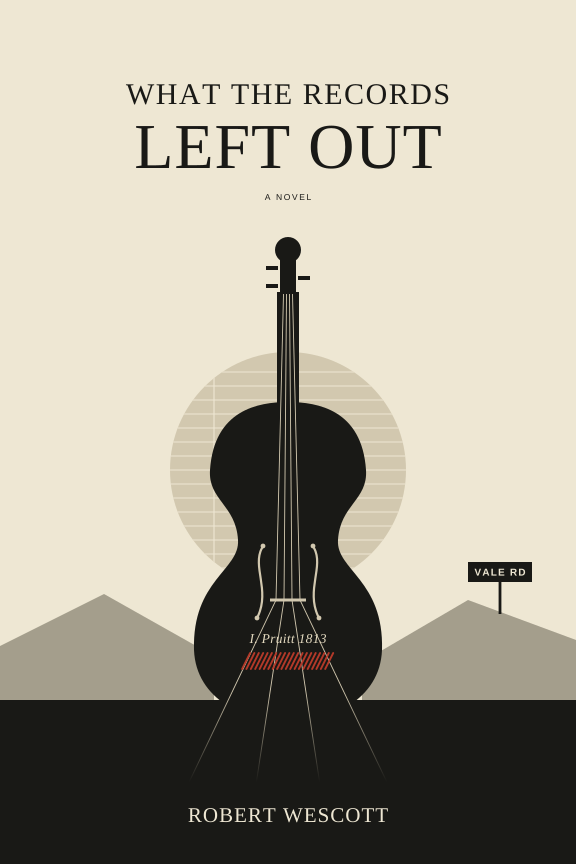
What the Records Left Out, by Robert Wescott, began with a family history.
The source material included historical documents, inherited stories, land transactions, a handmade fiddle, and a family legend whose chronology did not entirely hold together.
The ambition was to turn those fragments into a literary novel spanning two centuries.
One timeline would explore what happened when an account of the past became accepted history. The other would follow a contemporary man confronting the uncomfortable distance between his accomplishments, his failures, and the story he told himself about both.
AI could help research, structure, draft, and revise such a novel. But there was a more difficult question.
How do you prevent the tool from gradually replacing the author's particular understanding of life with its own plausible approximations?
That question shaped the project—and ultimately informed several of the principles behind PennedCanon.
The project at a glance
| Dimension | Project |
|---|---|
| Work | What the Records Left Out |
| Author | Robert Wescott |
| Genre | Literary fiction / historical fiction |
| Length | Approximately 95,000 words |
| Structure | 32 chapters, alternating historical and contemporary narratives |
| Primary source | Out of the Wilderness (2008), by Coral |
| Creative method | Author-directed, AI-assisted drafting and revision |
| Review | Multiple AI critiques, controlled editorial passes |
| Current status | Literary master selected; independent human reader validation and publication production outstanding |
1. Start with a story architecture, not a prompt
The project did not begin by asking AI to write a novel chapter by chapter.
It began with a structured narrative plan.
A five-act architecture established the central progression. A novel bible tracked characters, historical material, fictional transformations, and narrative rules.
Twenty-three critical scenes, totaling approximately 21,000 words, were drafted before the complete manuscript.
These scenes became structural guideposts. They established moments the surrounding narrative needed to earn.
This approach did not guarantee good writing. It did, however, make the process more deliberate. The AI was working toward an established dramatic structure rather than continually inventing the next development.
The PennedCanon lesson: A scene should have a purpose before it has prose. Canon, structure, and authorial decisions should persist beyond any individual AI conversation.
2. The AI invented a believable mixer. The author remembered the real one.
One of the most revealing moments came during the contemporary narrative.
AI had generated plausible details about operating a bakery. They sounded reasonable. They were also wrong.
The author had actually purchased an $800 mixer through Facebook Marketplace. Moving it involved a mower jack. The equipment, physical labor, and economics of the operation were more complicated than the generated scene suggested.
Other details needed similar corrections: the work schedule, employer, farm-stand payments, inventory practices, and the realities of driving a school bus.
None of the original inventions necessarily looked like obvious mistakes to a reader.
That was the problem.
The AI could produce convincing descriptions without knowing whether they were true to the character's circumstances or the author's experience.
The revision process changed when the author was asked to identify what had been invented and replace it with what he actually knew.
The resulting material became more specific. More importantly, the details began influencing the characters' actions rather than merely decorating the scenes.
The PennedCanon lesson: Before generating a scene, identify what the author knows, what the sources establish, what the AI is assuming, and what is intentionally fictional.
This experience inspired the proposed Origin Ledger and Author Interview workflow.
Read the verified example: the mixer before and after
Chapter 12 · Two Hundred Loaves · Author-supplied detail
Earlier draft
The mixer came on Monday of Thanksgiving week, in a box big enough to hold Nell. He had ordered it Tuesday night, about ten hours after Linda's photos, sitting on the edge of the bed in the dark with his phone held low so the light wouldn't wake Miriam. Eight hundred and twelve dollars with shipping. A spiral mixer with a steel bowl and a motor the size of a coffee can, and a capacity, it turned out when he finally read the manual on Monday night, of a little under half of one of his batches.
Source: archived manuscript before the audit, Chapter 12.
Selected literary master
He found the mixer on Tuesday night, about ten hours after Linda's photos, sitting on the edge of the bed in the dark with his phone held low so the light wouldn't wake Miriam. It was on Facebook Marketplace, out of a pizzeria in Easton that had closed in October: a twenty-quart planetary mixer, gray, with a stainless bowl and a wire guard over it and a dough hook, eight hundred dollars, cash, you pick up. He messaged the man before he could talk himself out of it.
There was the jack in the barn. It was the lift he used for the riding mower when he changed the blades, a red scissor jack with a foot pedal and a flat steel deck. He wheeled it in across the kitchen floor on its little casters, strapped the mixer to the deck, and pumped it up one stroke at a time until the base was level with the table. Then he slid it across. It took an hour. When it was done he sat on the floor with his back against the table leg, and Pickle came and smelled the mixer all over, carefully, and then smelled him.
Source: Draft 10 master, Chapter 12. Two non-adjacent paragraphs; the intervening pickup paragraph is omitted.
The decision
The revision replaces an online order and shipped mixer with the author’s Marketplace purchase and the practical problem of moving it. The retained project record and production debrief identify the mixer and mower jack as author-supplied experience. These are actual version excerpts, not a recreated model demonstration.
3. A polished sentence can make a novel worse
The manuscript underwent repeated editing passes.
Some were useful. Mechanical checks identified recognizable constructions and stylistic habits the author wanted to avoid.
Other passes created a subtler problem.
As the prose became smoother, it sometimes became less distinctive.
AI tended to regularize sentence rhythms, clarify implications the reader could already understand, and replace unusual details with more familiar language.
A paragraph might improve in isolation while the novel lost something across hundreds of pages.
The author noticed the effect before the editing process reliably identified it.
The response was to stop generalized polishing and establish a rule: future revisions required a specific target, a stated reason, and a reviewable change.
The PennedCanon lesson: Revision should be governed. The software must not assume that more fluent prose is always better prose.
A useful revision tool should show what changed, why it changed, and what might have been lost.
4. The author's voice needed more than a style prompt
A voice profile was eventually assembled from the author's own writing, communication patterns, preferences, and explicit instructions.
It was tested on a single scene before broader use.
The process established a hierarchy: the author's direct instructions took precedence over writing samples, which took precedence over generalized descriptions of voice.
That distinction mattered.
A writer's voice is not simply a collection of favorite words or preferred sentence lengths. It includes what the writer notices, what they leave unsaid, what they find absurd, and how they understand human behavior.
The strongest voice corrections did not merely make the sentences resemble the author's previous writing. They changed the assumptions behind the sentences.
The PennedCanon lesson: Voice preservation requires examples, explicit rules, protected intentions, and testing against real passages.
5. The most important revisions were sometimes rejected
The project used outside AI reviews to identify potential weaknesses.
Those reviews were not automatically accepted.
Some recommendations overlooked details that already had a purpose: a seemingly minor line that prepared a later revelation, a repeated geographical reference that connected scenes, or an object whose identity mattered to continuity.
An editor can identify a legitimate concern and still propose the wrong solution.
The author needed to distinguish between the problem and the proposed repair.
This became a central editorial principle: criticism is evidence to consider, not an instruction to obey.
The PennedCanon lesson: Every proposed change should be evaluated in context. Authors need a way to accept, test, reject, or defer suggestions while preserving the reasons for their decisions.
Read the verified example: a proposed cut the author declined
Chapter 25 · Earnest Money · A protected setup
The passage retained in Draft 10
On her way out Duke got up from under the radiator and walked her to the top of the stairs, slowly, the way he did for everyone. At the bottom she stood on the sidewalk in front of the hardware store window, where they had a display of seed packets and a sign that said PLANT BY MOTHER'S DAY, and looked at the asparagus crowns in their mesh bags in a bin by the door, twenty-five to a bag. She didn't buy them. You didn't buy them until you had somewhere to put them. She had known that since she was eight.
The recorded editorial decision
Outside restraint proposals (12 Nov): applied #2 (Cobb's forty years cut) and #3 ('answer to a different question' cut) in Ch 25. Declined the rest: Ch 1 self-correction, asparagus 'since she was eight' (it sets up the Ch 32 planting), Ch 29 reading and Elena, Ch 31 route.
Source: project revision notes, November 12, and the selected manuscript, Chapter 25.
Before and after the decision
The sentence “She had known that since she was eight.” appears in the earlier manuscript and remains in Draft 10. The revision notes record the suggestion to cut it and the reason for declining: it prepares Miriam’s planting in Chapter 32.
The complete external proposal is not preserved in this source package. No replacement wording is reconstructed here. This example verifies the retained passage and recorded rejection, rather than presenting a fabricated alternative.
6. AI could find errors. It could not certify literary quality.
The manuscript received repeated AI evaluations, many of them favorable.
Those evaluations were useful when they identified specific weaknesses.
They were much less useful when they assigned numerical scores to the work.
The systems evaluating the novel were often closely related to the systems that had helped create it. Some possessed extensive knowledge of the author's intentions and development history.
That is not the same experience as reading the finished book without explanation.
A human reader may misunderstand a revelation the author considers obvious. A character intended to be complicated may seem merely self-righteous. A quiet ending may be moving—or insufficiently resolved.
No amount of AI self-evaluation can establish those outcomes.
The PennedCanon lesson: Separate mechanical inspection, editorial judgment, and independent reader response. Do not market an AI-generated quality score as proof of literary merit.
7. Provenance became part of the creative process
The novel's underlying historical material raised questions about what survives in records, how family traditions change, and what happens when uncertain accounts become accepted facts.
The writing process raised a parallel question.
Where did the novel's material come from?
Some details originated in historical documents. Others came from personal experience. Some were invented deliberately. Others were proposed by AI and subsequently accepted, modified, or rejected.
The project developed a transformation ledger to distinguish those categories.
This was not merely an exercise in assigning credit.
It helped prevent historical invention from being confused with documentary evidence, and it gave the author a clearer understanding of how the novel had been constructed.
The PennedCanon lesson: Creative provenance should track the origin of ideas, the development of expression, the author's decisions, and the evidence supporting those claims.
A provenance record can document a process. It cannot, by itself, establish copyright ownership or literary quality.
8. The failures were as instructive as the successes
Several problems emerged during development.
The author and AI spent time reconciling separate manuscript copies. A piece of back matter disappeared from one package. Repeated names and a reused bus number escaped ordinary reading. Some scenes required substantial correction because AI-generated details had been accepted too early.
Most significantly, the manuscript still needed independent human readers.
These failures point to practical improvements.
A writing system should maintain one authoritative manuscript, preserve immutable versions, identify continuity conflicts, distinguish verified facts from assumptions, and prevent unapproved revisions from silently becoming final text.
It should also make it easy to export a clean manuscript for readers who have no knowledge of the writing process.
9. What this means for PennedCanon
What the Records Left Out did not prove that AI can produce great literature.
It demonstrated how much deliberate human direction may be required to produce a serious work while using AI extensively.
It also revealed the weaknesses of relying on disconnected conversations, repeated generation, and unstructured revision.
Those experiences inform six priorities for PennedCanon:
- Manuscript integrity: One authoritative text, protected versions, and author-approved revisions.
- Origin and evidence tracking: Distinguish lived experience, research, intentional invention, and AI assumptions.
- Creative-intent protection: Preserve the author's decisions about characters, ambiguity, voice, and meaning.
- Continuity inspection: Find contradictions that ordinary editing may miss.
- Independent review: Separate AI critique from actual reader comprehension and response.
- Publication provenance: Produce accurate records of sources, creative decisions, revisions, and AI assistance.
Some of these capabilities are part of PennedCanon's existing design direction; others are proposed enhancements informed by this project.
The objective is not to automate the author's judgment. It is to give that judgment a more reliable place to operate.
10. What we would do differently next time
If the project began again, the author would be interviewed before AI drafted scenes involving his personal experience.
The voice profile would be established before the first chapter.
Historical claims would be classified and checked during planning.
Each principal character would have independent motivations and protected areas of disagreement.
Revision would be targeted from the beginning, with every accepted change recorded against an identifiable manuscript version.
And independent readers would enter the process earlier.
The goal would not be to reduce human involvement.
It would be to spend less time repairing avoidable AI assumptions and more time making meaningful creative decisions.
The larger lesson
The most consequential moment in the development of What the Records Left Out was not when the AI produced an impressive passage.
It was when the author recognized that a passage was wrong, supplied something only he knew, and required the manuscript to change.
That is a different understanding of AI-assisted authorship.
The value of the system is not measured solely by how much it can generate. It is measured by how effectively it helps a writer develop, challenge, protect, and complete a work that remains accountable to the writer's intentions.
AI can help write the sentences. The author must remain responsible for the book.
PennedCanon is being developed around that distinction.
About this case study
This case study draws on the documented development of Robert Wescott's What the Records Left Out, including project planning, revision notes, author-supplied material, AI evaluations, and a retrospective production debrief.
It is an author-project case study, not an independent assessment of the novel's literary quality or proof of PennedCanon's commercial effectiveness. Features described as proposed should not be understood as already available in the product.
Project: What the Records Left Out
Author: Robert Wescott
Date: November 2026
Publication status: Preparing for print production and independent reader review.
Source and verification notes
The quotations above were checked against the protected Draft 10 package and its archived drafts and revision notes on November 12, 2026.
The master contains 32 chapter headings and approximately 95,000 words including front and back matter. Its source credit names Out of the Wilderness (2008), by Coral M. Wescott Swartz Sobczak. The approved front-cover SVG is reproduced unchanged. The manuscript and its private development records are not offered as public downloads.
Project history and the author’s decisions are reported from those records. They are not independent reader findings. The examples show a correction and a retained choice, not a measured advantage over another writing method.